

English translation of a work presented at the Conference on A⸫ A⸫, march 2021.
Orderings of a variety of types appear daily in conversations and discussions between the members of the esoteric community and are object of a variety of studies and academic and artistic productions. About objects in general, we find them in schemes, diagrams and tables, as in the notorious “tree of life”. About people in society, we find them in hierarchical, well defined structures, the fraternities and the Orders.
In this last sense, Order has as typical character the distribution of subjects in well defined positions inside a hierarchical or vertical organizational structure. We may trace the long history of this idea of “Order”, through History, through the cenobitical orders, communities of novices and monks governed by the Abbot and the Rule, and the artisans’ guilds, composed in its majority by apprentices and journeymen governed by an elite or council of master craftsmen and by the Statute. So too, in its varied forms, the Orders show hierarchical structure where we find their members distributed in positions below and under the government of one or more Masters.
This characters converses with an element typical of western thought: the constitution of the universe as a great scalae naturæ, a universe created by the ens perfectissimum, the primum mobile, the increated creator, “step” by “step”, link by link, from higher to lower level of perfection, from the most sublime to the lowest and most disgraced. In his pioneer study on the history of ideas, Arthut Lovejou analyses this conception, identifying its elements, and evidencing its presence in western thought from its first records in Plato to the Romanticism of the XIX century. Wouter Hanegraaf, reflecting on this matter, defined: Este caráter dialoga com um elemento típico do pensamento ocidental: a constituição do universo como uma grande scala naturæ, um universo criado pelo ens perfectissimum, o primum mobile, o incriado criador, de “degrau” em “degrau”, de elo em elo, de nível em nível de perfeição, do mais elevado e sublime até o mais ínfimo e desgraçado. Em seu pioneiro estudo sobre a história desta concepção, Arthur Lovejoy analisa essa concepção, identificando seus elementos, e evidencia sua presença no pensamento ocidental a partir de seu registro nos diálogos de Platão até o Romantismo do século XIX. Wouter Hanegraaf, refletindo sobre o assunto, define: “the ‘great chain of being’: the boundless creativity of the divine source was believed to have resulted in the enourmous diversity of the universe, from the most exalted angelic intelligences to the lowest animal creatures, all of which had their divinely appointed place in an ordered hierarchy that stretched out between the ultimate poles of spirit and matter.”
The conception of the universe as a hierarchy where every being occupies its proper place harmonizes well with a society highly stratified with minimal social mobility. As through the generative potency of the ens perfectissimum the great chain of being owes its existence, so also through the potency of the king the whole medieval society, from the most noble duke to the most miserable begar, owes its ordering. As every being in the great scala naturæ occupies its proper place, so also every subject in human society occupies its proper position, peasants and nobles, novices and monks, apprentices and journeymen.
In current times, one of the main prototypes for the organization of esoteric societies is the “Hermetic Order of the Golden Dawn”, from which many organizations currently active derive its form, as is the case of A⸫ A⸫. Its history inserts itself in the larger history of “rosicrucianism”, whose main lines may found in the works of Christopher McIntosh.
One of the oldest references to this Order occurs in a manuscript preserved at Biblioteca Nazionale di Napoli, dated to 1678, where, among other texts, we find the “Osservationi inviolabili da osservarsi dalli Fratelli dell’aurea croce ò vero dell’aurea rosa, precedenti la solita professione”, editado por Alessandro Boella e Antonella Galli. In this Statute, composed of 47 rules, we find an ordering similar to that of a monastery: a community of novices and fratri governed by an imperatore. We meet the rule of these fratelli again in “Gesetze oder Reguln der Brüderschafft des göldnen Creutzes”, by Sincerus Renatus, published in 1710, currently available in digital facsimile by the Bayerische Staatsbibliothek and in an english translation edited by R. A. Gilbert.
Decades later, emerges in germanic lands the “Orden der Gold- und Rosenkreuzer”. In his works on the history of Rosicricianism, Cristopher McIntosh reports on the structure of the Order based on a document titled “Pro Concordia Fratrum R. et A. Crucis, Planus principalis poſt Revolutionem univerſalem, A. D. 1767”, reproduced at the end of a panflet called “Rosenkreuzery” by ignác Aurél Fessler, currently available in digital facsimile by the Bayerische Staatsbibliothek. The members of the Order distributed themselves in none degrees of progressive perfection, from the lowest Junior to the highest Majus. The members organized themselves in Circles of up to nine members, each Circle governed by a Directory, himself responsible to the Imperator. We find this structure yet again centuries later in the “Societas Rosicruciana in Anglia”, still in activity, whose nine degress divide themselves in three orders, each sub-order representing a jurisdiction progressively larger, the lowest order over a small group of members, the median order over a number of instances of the lower order, and the supreme order over all inferiors, each jurisdiction with its chief, all subordinated to the supreme chief.
Though accessible to the historian, these structures belong to the secret or intimacy of each society, and even its publications are directerd to their members. After the schisms in the “Hermetic Order of the Golden Dawn” in the beginning of the XX century, and the subsequent publication of a complete set of documents from the Order, including instructions and secret rituals, initiated by Aleister Crowley in his “The Equinox”, these structures fall definitively in the public domain. This order, known informally as “Golden Dawn”, is composed of eleven degrees, from Neophyte to Ipsissimus, distributed in three sub-orders, the “Hermetic Order of the Golden Dawn”, the “Order of the Rosy Cross” and a mysterious third order. As these three orders represent a hierarchy of levels of perfection, so also the eleven degrees, and the grand structure of government by the triad Praemonstrator-Imperator-Cancellarius, and the small strucuture of governemnt of the lodges and temples where day to day activities occur, each person occupying their proper and adequate place. This strucuture is represented frequently by the diagram found in “The Temple of Solomon the King”, part 2, published in “The Equinox”, volume I, number 2, reproduced below from the digital facsimile by the “Scans from the Equinox” project by KeepSilence.org.

So, we find beings and subjects always arranged in a hierarchic structure, initiated or headed by the most perfect, pure and potent, descending by degrees to the inferior extremity. As in the great Order of the world each position is characterized by a nature with its signs, also in the small Order of human beings each position corresponds to words, colors, symbols, apparel, weapons, incense, secrets, instructions, rights and duties, all things connected with every other things, but, separate by frontiers sufficiently characterized. So, we reach the current notion of the scheme of the Order as a “map” and an inverted construction where we depart from the ordering of human beings to the great Ordering of the Universe.
This attitude of taking the Order in this manner, as a positional arrangement of subjects in hierarchic positions representative of degrees of excellency or perfection, is attested by the manner in which their members apply this principle. In the masonic community, we find the practice of mutual positioning, where subjects of a certain degree of a certain order are transposed directly to another degree of another order, through the identification of rules of equivalency. In A⸫ A⸫, there are diverse cases of direct positioning by various rules. There are two notable cases of posthumous positioning by virtue of published works: Eliphas Levi positioned 7○ = 4□ by virtue of his works “Dogme et Rituel da la Haute Magie” and “Clef des Grands Mystères”, and Helena Blavatsky positioned 8○ = 3□ by virtue of the work “The Voice in the Silence”. There are at least two known cases of positioning by direct, special recognition: Charles Stansfeld Jones positioned 8○ = 3□ as recognized by his discovery of 31 as key to the interpretation of Liber Legis, and Karl Germer positioned 8○ = 3□ as recognized by the effects of his experience while imprisoned in nazi concentration camps. In all these cases, we have subjects compared to a rule which gives them their measure: this subject is here, that subject is there, all adequately positioned in a scale of subjects. This practice leads to the conception of the System as a Rule to measure Subjects.
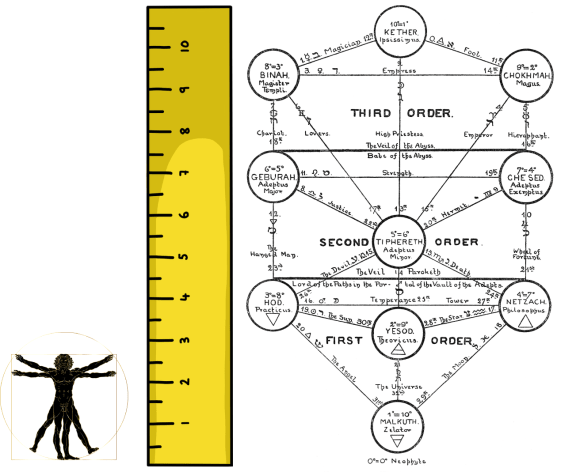
Of course, while the scala naturæ implies all things actually being or having the obligation to be at their proper places, and all these arrangements and diagrams represent these places and their mutual relations in static images, esotericism is far from asserting or demanding imobility. On the contrary; by the side of the “flaming sword”, downwards, is the “dragon of wisdom”, upwards. Analysing the world visions proper to western esotericism, Wouter Hanegraaf identifies this radical dualism. The “world” conventionally known is the double, the image, the inferior of the other “world”, superior, truthful, beautifyl. The place of the human being is this inferior world as designed by the Creator in the plan of creation.
It is possible, however, to this human being, to variate this condition: there are conditions to transit, to mobility inside this structure. In the mass of texts known as “hermetica”, we find doctrines of the ascension of the human being in the great ladder through various techniques of meditation, renouncement, mortifications, through direct contact with divine forces etc. This idea of vertical movement, be it by the upwards movement of the human being in the direction of the divine, be it the downwards movement of the divine element into humanity, Hanegraaf calls “platonic mediation” between the two elements of esoteric dualism.
Christopher McIntosh reports on the process by which a young member of the “Orden der Gold- und Rosenkreuzer”, admited to the degree of Junior, ascends through the grades. The member must apply himself to the study of texts, books and manuscripts, provided by the Order, but, also, to accomplish the proposed alchemical experiments and report on the result. The ascension of the member is effected by the realization of ceremonies, with its movements and sayings, examinations, oaths, explanations and investiture, which attest its masonic lineage.
In the “Hermetic Order of the Golden Dawn”, the young Neophyte of the first order didicates herself to the study of lessons progressively accessed through the ceremonies of initiation in each grade, being the access of the next grade mediated by theoretical examinations on the previous grade. After the transition to the second order, it is expected that the young Adapt will apply herself to put this knowledge into practice and ascend based on the practical results thereof.
The plan of work for the first order of A⸫ A⸫ was published in 1910 in the book “Graduum Montis Abiegni”, in “The Equinox”, volume I, number 3. In this document, subtitled “A Syllabus of the Steps Upon the Path”, we find succint declaraions of the duties of each grade. Taking the Practicus as example, the member must study lessons in Qabalah and Liber DCCCLXXVII, lessons in philosophical meditation and jñana yoga, lessons in some mode of divination of her choice, lessons the control of speech, topics on which she shall be examined. Her ascension shall happen as soon as her superior authorizes, supposedly as function of recognition of the satisfaction of all requirements. No document equivalent to “Graduum Montis Abiegni” has been officially published for the grades of the seconds order.

Following “Graduum Montis Abiegni”, the macro structure of the Order with its three great divisions is described authoritatively in a class A titled “Tau vel Kabbalae Trium Literarum” published in “The Equinox”, volume I, number 7. In this document, the three orders are explained by seven interpretants, in triads associated to hebrew letters, the 21 triads summarized in the last letter, ת. We have, for example, on the ordeals of initiation: under the letter ט, the third order, “birth”; under the letter נ, the second order, “death”, under the letter ש, the first order, “ressurrection” .
The plan of work received additional elaboration in 1930 with the publication of the paper “One Star in Sight” in the appendix to “Magick in Theory and Practice”. In this document, the general plan of the order is drawn, from Ipsissimus to Neophyte, with elaborations on the grades of the third and second orders, filling the void left by “Graduum Montis Abiegni”.
From this text, the following fragment brings us a new element: the idea of event.
The outline given of the several successive steps is exact; the two crises — the Angel and the Abyss — are necessary features in every career. The other tasks are not always accomplished in the order given here; one man, for example, may acquire many of the qualities peculiar to the Adeptus Major, and yet lack some of those proper to the Practicus. But the system here given shows the correct order of events, as they are arranged in Nature; and in no case is it safe for a man to neglect to master any single detail, however dreary and distasteful it may seem.
The chracter of each grade is recognized as the measurement of subjects: there are the “qualities peculiar to the Adeptus Major” which some subject may very simply possess. However, the acquisition of these peculiar qualities, understood as events, have an appropriate position in time: there are those which must be acquire first, those which must be acquired later, and then others later, and then others. In a note, this matters is elaborated and the rule of the Order explicitly declared.
The natural talents of individuals differ very widely. (…) a brilliant Exorcist might be an incompetent Diviner. In such a case the A⸫ A⸫ would refuse to swerve from Its system; the Aspirant would be compelled to remain at the Barrier until he succeeded in breaking it down, though a new incarnation were necessary to permit him to do so.
The only weakness in these words is its position as a footnote: the text itself is precise and uncompromising. A member who does not acquire one of the qualities required by the current stage, no matter how many qualities he shoud possess peculiar to later stages, shall remain in his current stage. This rule conflicts with the possibility of taking the System as a mere Rule of measurement: even if one should measure a certain subject by this Rule to have all the qualities of “height 10”, that is not enough for that subject to be recognized as such.
There is a correct ordering to the acquisition of these characteristics, independent of what may eventually happen by natural talent or by chance. The Order prescribes a course in time whose stages must be followed in order and whose traversal shall be recognized in order. This traversal is described explicitly as successive events: the accomplishment of tasks, the acquisition of qualities, the overcoming of barriers are all events.
The very idea of movement implies the idea of time. There being mobility in the great ladder, there being the possibility of an inferior to ascend or a superior to descend, there is movement, therefore the progress of time. Apart phenomena peculiar to the quantum world, all movement in space through time traverses all intermediary positions: to go from here to there, one must traverse all positions in between. To reach an intermediary position is a required condition to reaching the final destination.
In conceptualizing the solution to a problem or the doing of some action by the metaphor of traversing a course, those things which are requried conditions to solving the problem or doing the thing are represented as intermediary stages. The common experience finds such conditions everywhere and in all times; one must pre heat the oven into the correct temperature in order to properly cook a certain dish; one must use the correct amount of force in order to push a broken car. While the typical western representation for hierarchies are vertical figures, with Above and Below, the typical representation for processes are horizontal figures, with Before and After.

The comprehension of the System as an Ordering of Time offers diverse new possibilities of analysis and application, in particular the perspective of processes in contrast with hierarchies, and the idea of necessary conditions in contrast with merits and dignities. Based on this new perspective, we believe it is possible to find new understandings on the intentionality of the System and its contituent parts as a function of the peculiar effect that emerge from its ordering. Additionally, we believe that this temporal perspective permits a new reading of this structure from “possessing a grade” to “being at a grade”, which appears to us extremely frutiful to those who are living the corresponding process.
Bibliography
Aleister Crowley, “Liber Graduum Montis Abiegnis”, in “The Equinox”, volume I, número 3, facsimile digital, KeepSilence.org, URL:https://keepsilence.org/the-equinox/1.3/liber-graduum-montis-abiegni_low.pdf
Aleister Crowley, et al, “Magick”, segunda edição revisada, Weiser Books, 1997, ISBN 9780877289197
Alessandro Boella, Antonella Galli, “L’alchimia della confraternita dell’Aurea Rosacroce”, edição digital, Edizioni Mediterranee, 2013, ISBN 9788827223567
Arthur Lovejoy, “The Great Chain of Being”, Harvard University Press, 1936, ISBN 0674361539
Christopher McIntosh, “The Rosicrucians”, terceira edição, Weiser Books, 1998, ISBN 9780877289203
Christopher McIntosh, “The Rose Cross and the Age of Reason”, Suny Press, 2011, ISBN 9781438435596
Guido del Giudice, “Giordano Bruno e i Rosacroce”, in “la Biblioteca di Via Senato”, 10, 07-14, 2013, URL:https://philpapers.org/rec/GIUGBE
Ignaz Aurelius Feßler, “Rosenkreuzery”, Rudolstadt, ca. 1805 – 1806, facsimile digital, Bayerische Staatsbibliothek , URL:http://mdz-nbn-resolving.de/urn:nbn:de:bvb:12-bsb10446372-1
J. F. C. Fuller, “The Temple of Solomon the King”, parte 2, in “The Equinox”, volume I, número, 2, facsimile digital, KeepSilence.org, URL:https://keepsilence.org/the-equinox/1.2/the-temple-of-solomon-the-king-part-2_low.pdf
Sincerus Renatus (alias Samuel Richter), “Gesetze oder Reguln der Brüderschafft des göldnen Creutzes”, in “Die Warhaffte und vollkommene Bereitung des Philosophischen Steins der Brüderschafft aus dem Orden des Gülden- und Rosen-Creutzes”, Breßlau, 1710, facsimile digital, Bayerische Staatsbibliothek, URL:http://mdz-nbn-resolving.de/urn:nbn:de:bvb:12-bsb11109773-1
Wouter Hanegraaf, “Western Esotericism: a Guide for the Perplexed”, edição digital, Bloomsbury Academic, 2013, ISBN 1441136460
 Pedro Lamarão
Deixe um comentário